
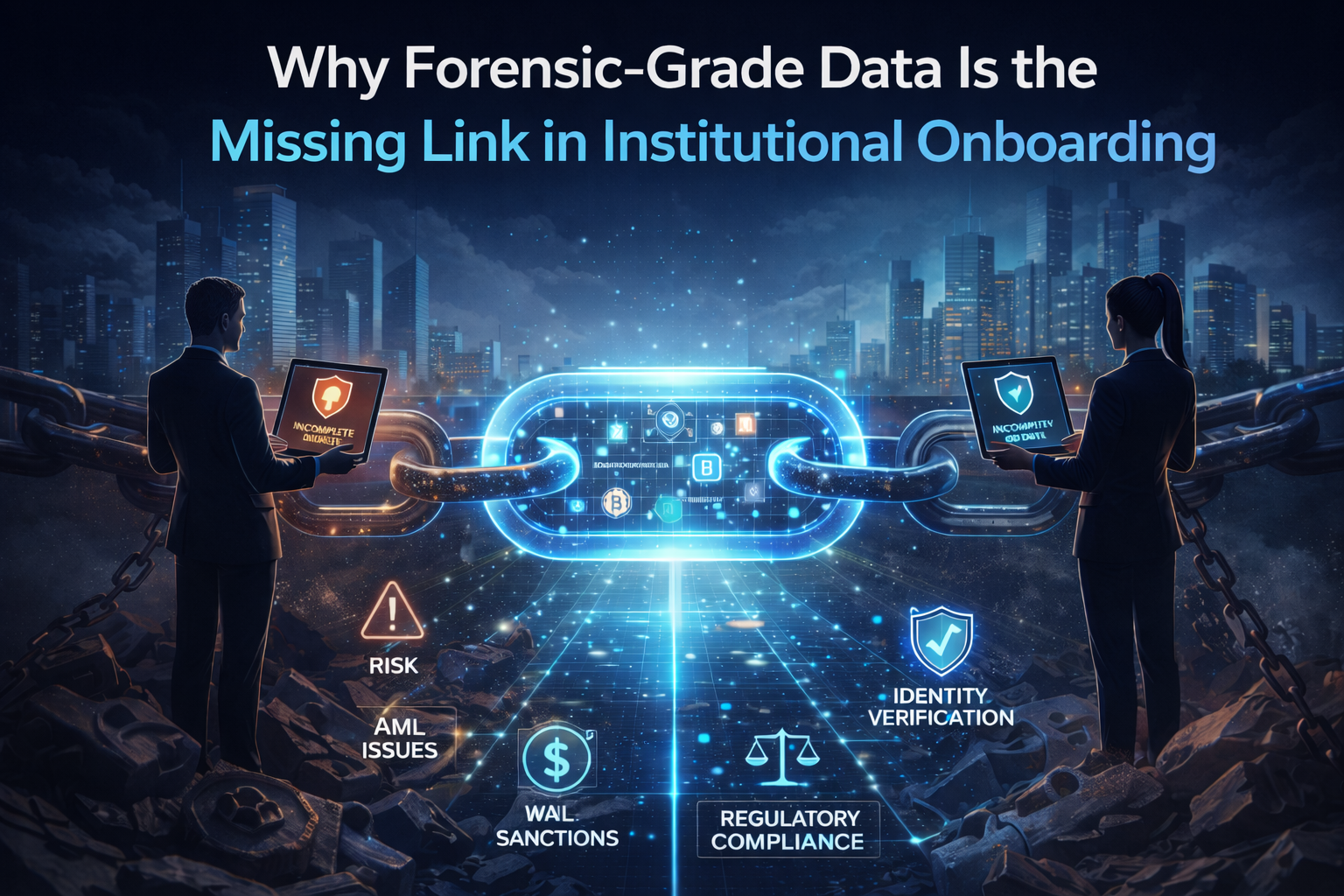
For institutional asset managers, crypto hedge funds, and venture capital firms, onboarding is the single greatest moment of risk. The core mandate of a fiduciary is capital preservation and limited partner (LP) protection. Yet, in the rush to deploy capital into high-growth digital assets, many firms are relying on compliance tools designed for retail exchanges.
This is a critical oversight. Static screening and generic blacklists provide a superficial layer of protection, but they do not provide the depth necessary to uncover sophisticated illicit actors. When onboarding institutional-scale capital, you need Forensic-Grade Data.
The False Sense of Security: Why Shallow Data Fails
Traditional compliance tools primarily rely on “blacklists”—static databases of known bad actors and sanctioned addresses. While necessary, this approach is fundamentally reactive. It only flags an entity after it has been publicly identified and labeled.

Sophisticated money launderers and sanctioned entities do not use their “primary” addresses. They utilize a vast network of intermediate wallets, nested exchanges, and decentralized protocols to obscure the ultimate origin or destination of funds.
Shallow data fails to see beyond the initial transaction. A standard AML tool might scan a potential client and find no immediate red flags. They pass. However, a forensic-grade audit would reveal that this “clean” wallet is, in fact, two hops away from a confirmed North Korean hacking group or a darknet drug market.
This “False Negative” is the primary threat to an institutional fund’s reputation and regulatory standing.
The ComplyChain DNA: Our Unfair Investigative Advantage
The distinction between shallow and forensic data is where CoinForensics truly shines. The proprietary technology behind our platform was forged by the senior investigative team at ComplyChain Solutions, led by Adnan Tahir.
Our algorithms are not trained on public data alone. They are infused with the investigative heuristics and behavioral patterns that our team has documented over years of high-stakes blockchain forensic cases. We built the platform to “think” like an investigator.
When your firm utilizes the CoinForensics Intelligence Suite, you are utilizing an Investigation-First methodology. Our tool performs a Continuous Heuristic Walk on every single onboarding entity, tracing the “reputation score” back to the source of funds, not just the nearest wallet.
Key Advantages for Institutions:
- Detection of “Nested” Exchange Wallets: We go beyond identifying the “exchange” and identify the underlying illicit service address, providing a true attribution of the counterparty.
- Behavioral Money Laundering Flags: Our AI automatically flags patterns of “peeling chains,” “dusting,” and “layering” before the address is ever officially added to a blacklist.
- Audit-Defensible Proof: Generate forensic-grade reports for your LPs and your board, proving that you exercised maximum due diligence for every onboarding decision.
Conclusion: Due Diligence is Non-Negotiable
As institutional capital floods into the digital asset space, the definition of “due diligence” is being redrawn. Relying on basic screening is no longer defensible. For fiduciaries, forensic-grade attribution is not a luxury—it is the prerequisite for security.
Ensure your firm’s due diligence is exhaustive, defensible, and built on the pedigree of expert investigation.
Visit ComplyChain Solutions to learn more.
Learn more about CoinForensics

Leave a Reply